VIEW:
ACADEMIC 2026-2027 • INTERACTIVE STEM ROBOTICS SIMULATION
Master 21-DOF Humanoid Robotics in Real Time
Step inside a physics-accurate 3D humanoid sandbox built for students, robotics clubs, and engineering teams. Master forward and inverse kinematics, compute Zero-Moment Point (ZMP) stability polygons, choreograph bipedal gait cycles, and automate routines with real code—all in your browser with zero hardware risk.
🔒
Google Sign-In required to enter the live cockpit & persist your robotics code routines in Firebase Cloud. Free for students.
21
Joint Actuators
Full 3D Kinematics
ZMP
Dynamic Balance
Live Polygon Physics
60 FPS
In-Browser WebGL
Zero Installation
CLOUD
Firestore Sync
Google Account Save
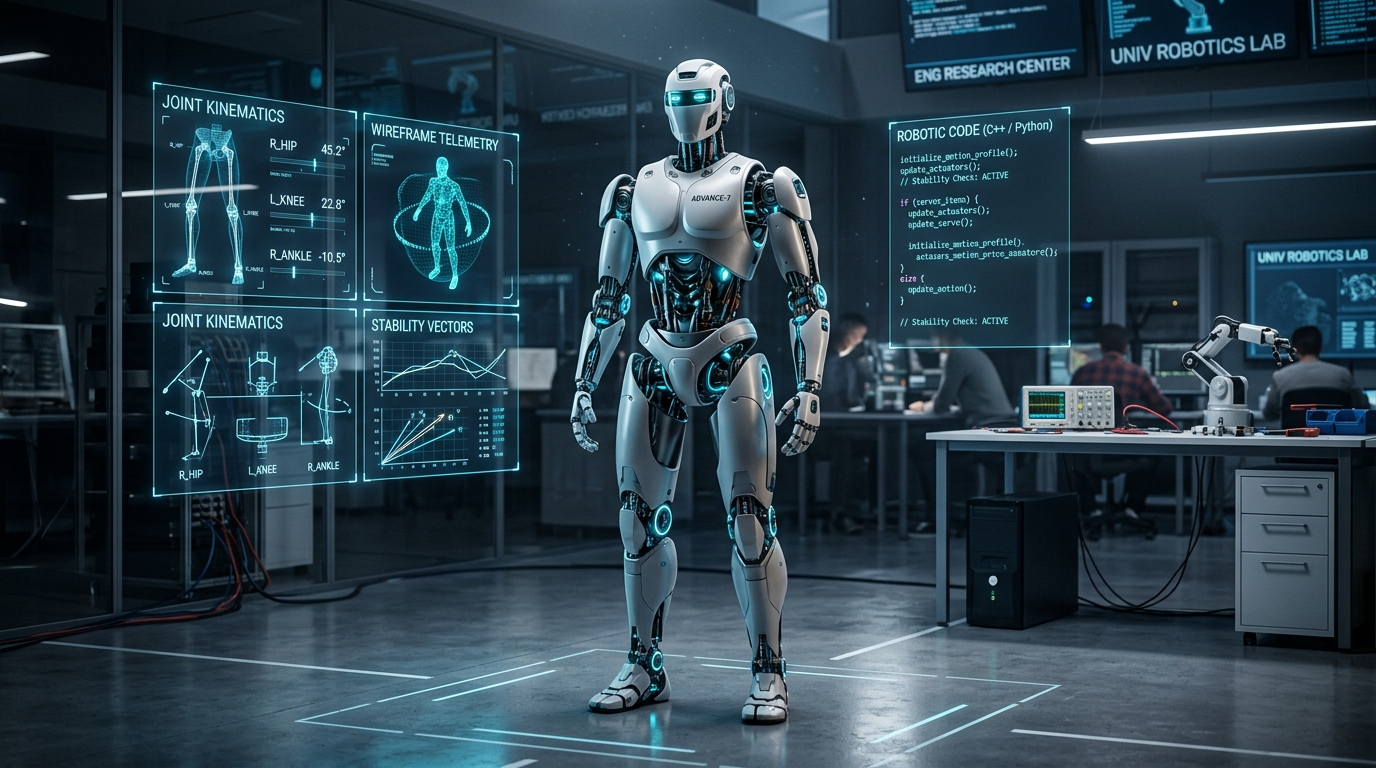
KINEMATIC MATRIX
L_KNEE: -34.2°
R_HIP_PITCH: +18.0°
TORSO_YAW: 0.0°
BALANCE: EQUILIBRIUM
CoM MARGIN: +4.8 cm
SUPPORT: DUAL FOOT CONTACT
ZMP CRITERION: SATISFIED
HUMANOID.OS v2.4 • SYSTEM OPERATIONAL
HANDS-ON EXPLORATION
Interactive Robotics Mini-Lab
Experience core robotics engineering concepts right here in your browser. Test dynamic stability, inspect joint degrees of freedom, analyze bipedal gait cycles, and preview robotic code.
Zero-Moment Point (ZMP) Rule: A biped robot remains stable if and only if the whole-body dynamic Center of Pressure stays strictly inside the convex hull formed by foot-ground contact pads.
●
STABLE EQUILIBRIUM (DUAL STANCE)
STABILITY MARGIN TO EDGE:
+6.5 cm
TOPPLE HAZARD:
0.0% [NOMINAL]
Bipedal Leg Subsystem (6 DOF per limb)
Configured with 3-DOF spherical hip assembly (yaw, roll, pitch), 1-DOF high-torque knee revolute actuator, and 2-DOF universal ankle gimbal.
| Joint Identifier | Motion Axis | Limits (Deg) | Actuator Specification |
|---|---|---|---|
| hip_y_l | Yaw (Rotation) | -45° to +45° | Planetary Brushless 48V |
| hip_r_l | Roll (Abduction) | -25° to +25° | High-Stiffness Harmonic |
| hip_p_l | Pitch (Flexion) | -90° to +30° | Dual Cycloidal 60Nm |
| knee_p_l | Pitch (Flexion) | -120° to 0° | Direct Drive Linkage |
| ankle_p_l | Pitch (Dorsiflex) | -45° to +45° | Dual Tendon Actuator |
| ankle_r_l | Roll (Inversion) | -20° to +20° | Differential Gimbal |
PHASE 01 • 0% - 25%
Double Support Stance
Both feet remain firmly on ground plane. Pelvis translates laterally toward stance leg, moving whole-body Center of Mass over the upcoming support polygon.
PHASE 02 • 25% - 50%
Single Support & Swing
Right foot lifts off. Knee flexes to -35° for ground clearance. Inverted pendulum dynamics govern forward kinetic momentum while arms swing counter-phase.
PHASE 03 • 50% - 75%
Heel-Strike Impact
Right heel strikes ground ahead of pelvis. Ground Reaction Forces (GRF) absorbed by compliant ankle pitch servos; kinetic energy transfers smoothly into stance.
PHASE 04 • 75% - 100%
Left Swing & Push-Off
Left ankle initiates rear push-off impulse. Cycle mirrors symmetrically to complete a smooth, continuous bipedal walking stride without falling.
Current Gait Generator: Parametric Cycloidal Trajectory
student_routine.js — Humanoid.OS Studio
● SYNTAX VALID
// Interactive student balance & gesture routine
async function dynamicWaveAndSquat() {
// 1. Lower center of mass into stable crouch
await robot.smoothTransition({
knee_p_l: -35,
knee_p_r: -35,
hip_p_l: 20,
hip_p_r: 20
}, 400);
// 2. Raise right arm and salute
await robot.smoothTransition({
shoulder_p_r: -80,
elbow_p_r: 45
}, 500);
// 3. Verify ZMP equilibrium
const margin = robot.getStabilityMargin();
console.log(`Equilibrium margin: ${margin.toFixed(2)} cm`);
}
VIRTUAL SERVO BUS TERMINAL
[0.00s] Initializing kinematics bus for 21 servos...
[0.04s] All joint encoder streams synced at 1000Hz.
[0.08s] CoM position: [0.00, 0.89, 0.00] m. Status: STABLE.
[0.12s] Ready. Click 'TEST RUN CODE' below.
ENGINEERING FOUNDATIONS
Built for Modern Robotics Education
Bridge the gap between pure robotic theory and physical actuation with tools designed for university labs, high school STEM programs, and competitive robotics.
KINEMATICS
Forward & Inverse Kinematics
Understand transformations between world coordinate frames, base pelvis link, and 21 independent joint matrices with live numerical angle readouts.
DYNAMICS
Zero-Moment Point Stability
Compute dynamic Center of Mass (CoM) coordinates and visualize live support polygon margins to prevent catastrophic bipedal tip-over.
SCRIPTING
In-Browser Code Studio IDE
Write, debug, and execute JavaScript control routines with async keyframing, timeline scrubbing, and instant virtual console telemetry feedback.
CLOUD STORAGE
Google Cloud Firestore
Log in with Google to automatically store your custom routines, keyframe motions, and joint configurations securely in the cloud.
MODULAR LEARNING ROADMAP
Structured Robotics Curriculum
A comprehensive, 5-stage laboratory sequence curated for undergraduate mechatronics courses, robotics clubs, and hackathon teams.
LAB 01
Kinematic Chains & Coordinate Transforms
BEGINNERMap degrees of freedom across head, arms, and bipedal legs. Learn right-hand rule conventions, Euler angles, and physical actuator joint limits.
LAB 02
Center of Mass & Static Equilibrium
INTERMEDIATECalculate whole-body CoM from segmented link masses. Trace convex support polygons and experiment with single-foot balancing maneuvers.
LAB 03
Dynamic Bipedal Walking & Inverted Pendulum
INTERMEDIATEGenerate cycloidal swing foot trajectories, balance lateral momentum with torso counter-pitch, and maintain positive ZMP stability margins.
LAB 04
Algorithmic Choreography & Keyframe Scripting
ADVANCEDProgram complex multi-joint routines in the Code Studio. Use cubic splines to interpolate between keyframe poses with zero servo jerk.
LAB 05
Sim-to-Real Hardware Deployment
CAPSTONEExport joint angles and trajectory time-series configurations to JSON ready for physical microcontrollers, Arduino, ROS2, and servo buses.
STUDENT PERSPECTIVES
Why Future Roboticists Love Humanoid.OS
See how students and team mentors use Humanoid.OS to simulate ideas before cutting metal or burning motors.
"Before Humanoid.OS, testing a new walking gait meant putting our physical $8,000 robot on a harness and praying we didn't strip a gearbox. Now our entire team iterates on kinematics in the browser first."
"The live Center of Mass and Support Polygon visualization made Zero-Moment Point theory click for our high school team in 15 minutes. It's the most intuitive tool we've used for our robotics curriculum."
"Being able to sign in with Google and immediately save scripts to Firestore means our students can collaborate across different campus workstations without losing their keyframe sequences."
GOT QUESTIONS?
Frequently Asked Questions
Everything you need to know about getting started with the student robotics laboratory.
Do I need physical robot hardware or specialized software to use this?
No! Humanoid.OS runs 100% in any modern web browser via WebGL and Three.js. You don't need to install Python packages, ROS2, or own any physical actuators. All kinematics and stability calculations occur client-side in real time.
Why is Google Sign-In required to access the application?
Google Sign-In provides each student with a private, secure workspace. It connects your session to Google Firebase Firestore so that your custom scripts, timeline keyframes, and exported robot configurations are safely backed up to the cloud and accessible from any device.
Can I export my simulation routines to a physical humanoid robot?
Yes. You can export complete joint angle time-series configs directly to JSON via the top header bar. These JSON files map 1:1 to servo angle arrays that can be consumed by Arduino, ESP32, Raspberry Pi, or ROS2 controllers.
Is Humanoid.OS free for students and schools?
Yes, Humanoid.OS is free for educational use by students, educators, and robotics hobbyists worldwide.